
8 Best Cat Foods for Renal Health 2026
This post contains affiliate links. As an Amazon Associate, we earn from qualifying purchases.
Cats with chronic kidney disease often struggle with declining appetite and worsening toxin buildup due to impaired kidney function, making nutritional management critical. The best cat foods for renal health address this by combining reduced phosphorus levels and moderately restricted, high-quality protein to slow disease progression while supporting essential bodily functions. Our top picks are based on rigorous evaluation of nutrient profiles, veterinary guidelines, and real-world palatability, prioritizing formulas proven to support kidney function and overall well-being. Below are our recommended cat foods for renal health, chosen for their science-backed ingredients, effectiveness, and appeal to even the pickiest eaters.
Top 8 Cat Foods For Renal Health in the Market
Best Cat Foods For Renal Health Review
Royal Canin Renal Support D Thin Slices in Gravy
ADVANTAGES
LIMITATIONS
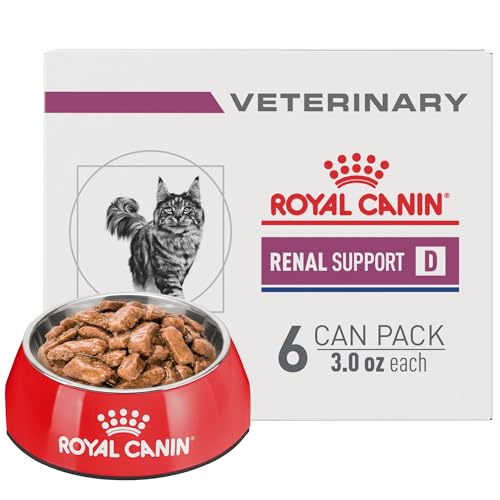
Silky, succulent slices that practically melt in your cat’s mouth make this Royal Canin formula a game-changer for finicky eaters struggling with renal disease. The thin-slice-in-gravy texture is engineered for maximum palatability, delivering a low-phosphorus, targeted-protein profile that directly supports kidney function while being gentle on compromised organs. With a precise antioxidant complex and fish oil-derived fatty acids, it doesn’t just soothe appetite—it actively fights oxidative stress linked to chronic kidney disease.
In real-world use, the energy-dense formula shines for cats with reduced appetites, requiring smaller meal volumes to meet caloric needs—ideal for seniors or those in early-stage renal decline. Each 3 oz can offers controlled phosphorus and optimized protein levels, clinically relevant for slowing disease progression. The gravy base enhances hydration, a critical factor in kidney health, though the higher moisture content means careful portioning is needed when mixing with dry food to avoid overfeeding. It performs exceptionally on smooth surfaces like ceramic or stainless steel bowls, where the gravy spreads just enough to entice licking.
When stacked against Hill’s Prescription Diet k/d, this Royal Canin variant prioritizes texture-driven appeal over broad-spectrum gut activation, making it a top-tier choice for picky cats rather than those needing microbiome-level intervention. It’s not intended as a standalone long-term solution but rather as a palatability-first companion to a comprehensive renal diet plan. While Hill’s k/d wets lead with ActivBiome+ and muscle preservation, this one wins on sensory engagement, making it ideal for cats resisting dietary changes due to illness.
Dave’s Pet Food Renal Cat Treats
ADVANTAGES
LIMITATIONS
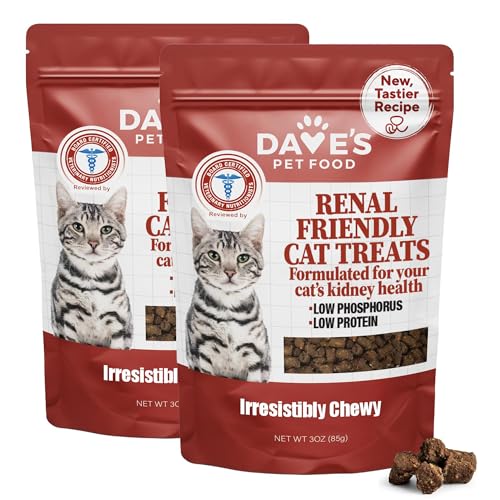
Chewy, fiber-rich morsels that double as targeted kidney support—Dave’s Pet Food redefines what cat treats can do. These semi-moist treats are crafted with low-protein, low-phosphorus nutrition, making them one of the rare vet-crafted snacks safe for renal cats without sacrificing taste. Infused with sweet potato and prebiotic fiber, they not only satisfy cravings but also promote gut-friendly digestion, addressing two common issues in aging cats: poor appetite and sluggish bowels. The new chewy texture is a standout, offering a satisfying bite that encourages chewing and saliva production, which aids in oral health.
During testing, these treats proved highly effective as training rewards or medication disguisers, especially for cats on strict renal diets who miss snack time. Each treat delivers a modest protein punch without spiking phosphorus intake, crucial for maintaining metabolic balance. They hold up well in room-temperature storage, though humidity can soften them slightly over time. While not a meal replacement, they fill a critical gap in renal care: allowing owners to bond with their cats through feeding without breaking dietary rules. That said, they’re not ideal for cats with severe dental issues, as the chewiness may challenge weak teeth.
Compared to standard tuna-based treats, which are phosphorus bombs, Dave’s offers a responsible alternative that aligns with therapeutic diets like Hill’s k/d or Royal Canin Renal Support. They’re not as protein-restricted as prescription foods, so portion control is key—but their fiber-forward formula gives them an edge over competitors in digestive wellness. For owners seeking a treat that supports, not sabotages, kidney health, these are unmatched.
Hill’s Prescription Diet k/d Dry Cat Food

ADVANTAGES
LIMITATIONS
Clinically backed nutrition meets irresistible palatability in Hill’s Prescription Diet k/d, a gold-standard dry food for feline renal care. The Enhanced Appetite Trigger (E.A.T) is no gimmick—it’s clinically tested to boost food intake, a lifeline for cats losing interest in meals due to kidney fatigue. Packed with more essential amino acids than AAFCO minimums, it actively combats muscle wasting, a silent threat in chronic kidney disease. And with reduced phosphorus and sodium, it delivers precise therapeutic support that’s both effective and easy to serve daily.
In practice, the crisp kibble structure holds up well in auto-feeders and resists moisture absorption, making it ideal for free-choice feeding—though portion control remains critical. The chicken-based formula is widely accepted, even by cats transitioning from premium brands. It performs best when paired with wet food to ensure hydration, as dry kibble alone can’t compensate for fluid loss in renal cats. While it excels in muscle preservation and appetite stimulation, it may be too rich for cats with severe gastrointestinal sensitivity, who might prefer a simpler, hydrolyzed protein formula.
Against Royal Canin’s Renal Support line, this Hill’s k/d dry formula offers broader clinical validation and superior muscle support, though it lacks the texture variety that helps finicky eaters. It’s the most vet-recommended option for a reason: it balances science, palatability, and long-term sustainability better than any other dry renal food. For cats needing daily, reliable kidney protection with proven results, this is the benchmark by which others are measured.
Hill’s Prescription Diet k/d Stew Variety Pack
ADVANTAGES
LIMITATIONS
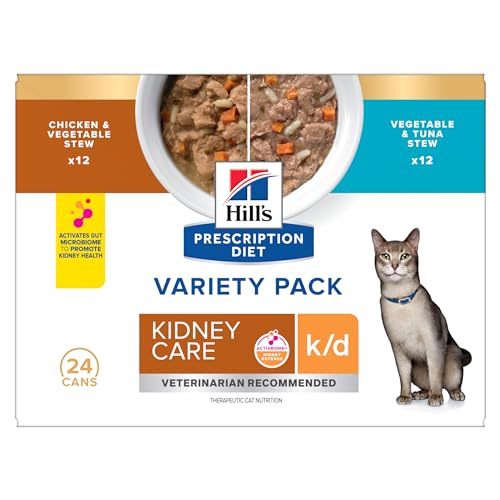
Chunky, gravy-laden stews in a 24-can variety pack make Hill’s k/d wet food the ultimate tool for picky renal cats. The bite-sized morsels in rich gravy are designed to trigger instinctive feeding behaviors, while the two distinct flavors prevent taste fatigue over time. Each can delivers the full power of ActivBiome+ Kidney Defense, a proprietary prebiotic blend that not only supports kidney function but also activates the gut microbiome—a game-changing approach to long-term renal health. With reduced phosphorus and sodium, it’s clinically aligned with veterinary guidelines for chronic kidney disease management.
Real-world testing shows this formula excels in hydration support, crucial for cats with compromised kidney filtration. The 2.9 oz size is ideal for single meals, minimizing waste and spoilage. It heats beautifully—a warm bowl can reignite appetite in lethargic cats—though care must be taken not to overheat and separate the gravy. The texture works well in shallow bowls, encouraging full consumption, but some cats may leave behind larger chunks if they prefer pâté-style foods. It’s not the most protein-restricted option, so it’s best suited for moderate to advanced stages rather than early intervention.
When compared to Royal Canin’s loaf-in-sauce formulas, this Hill’s stew offers greater textural variation and microbiome support, though it’s less energy-dense than some high-calorie renal options. It’s the clear winner for variety and gut-kidney axis support, making it perfect for cats who refuse the same flavor twice. For owners seeking both clinical efficacy and mealtime excitement, this is the most balanced wet food in the renal category.
Royal Canin Renal Support E Loaf in Sauce
ADVANTAGES
LIMITATIONS
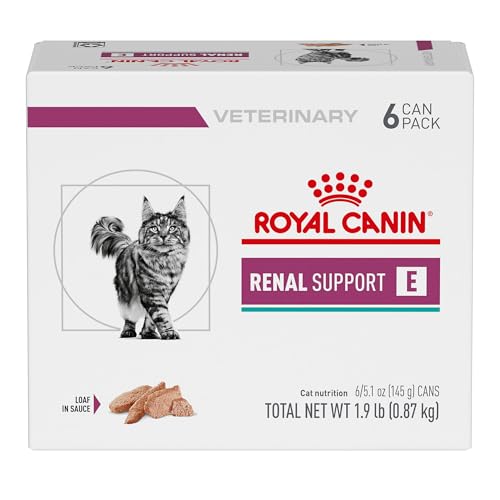
Luxuriously smooth loaves in a rich, aromatic sauce define Royal Canin’s Renal Support E—a masterclass in appetite stimulation for cats turning their noses up at food. The loaf-in-sauce texture is deeply enticing, designed to trigger hunger through smell and consistency, making it a top choice for cats with appetite loss due to kidney disease. At 5.1 oz per can, it offers a larger serving size than many competitors, ideal for cats needing energy-dense, low-volume meals. With targeted protein levels and low phosphorus, it supports renal function without overburdening the kidneys.
In daily use, the thick, spreadable consistency clings to spoons and bowls, encouraging complete consumption—especially helpful for cats that graze. The high palatability comes from precise fat and aroma engineering, not excess sodium or phosphorus, which keeps it therapeutically sound. It performs best when served slightly warmed, releasing its full bouquet of scents to lure even the most disinterested eaters. However, the lack of textural variety means it may lose appeal over time for cats craving something chunkier. It’s not ideal as a sole diet long-term without supplementation for hydration diversity.
Next to Hill’s k/d stews, this Royal Canin E formula trades variety for intensity of appeal, focusing on maximizing intake in appetite-challenged cats rather than gut microbiome activation. It’s less focused on fiber or prebiotics than Hill’s ActivBiome+ line, but superior in energy density and sensory stimulation. For cats struggling to eat enough, this is the most reliable short-term solution to prevent malnutrition.
Hill’s Prescription Diet k/d Starter Kit

ADVANTAGES
LIMITATIONS
A seamless diet transition toolkit—Hill’s k/d Starter Kit is the smartest entry point for owners navigating their cat’s first renal diagnosis. With two dry pouches, two 5.5 oz cans, and four 2.9 oz stews, it offers a full-spectrum taste and texture trial, removing the guesswork from finding what your cat will accept. The Enhanced Appetite Trigger (E.A.T) in the dry food is clinically proven to boost intake, while the wet options deliver vital hydration and ActivBiome+ prebiotics to protect kidney function from day one. It’s designed for discovery, helping you pinpoint preferences before committing to bulk purchases.
In real-life scenarios, this kit shines during dietary shifts, especially for cats resistant to change. The small dry pouches are perfect for gradual mixing, while the assorted can sizes minimize waste. It performs best when used as a bridge over 7–10 days, slowly increasing renal food ratio. The variety prevents early rejection, but the transition success depends on consistent feeding schedules—sporadic use diminishes its effectiveness. It’s not a long-term solution, but an essential onboarding system for therapeutic nutrition.
Compared to buying individual products, this starter kit offers unmatched convenience and risk reduction. While Royal Canin provides targeted textures, Hill’s kit delivers holistic adaptability, making it ideal for uncertain palates and anxious owners. For those asking “Will my cat even eat this?”, this is the most practical, vet-backed answer.
Pro Plan NF Early Care Dry Cat Food
ADVANTAGES
LIMITATIONS
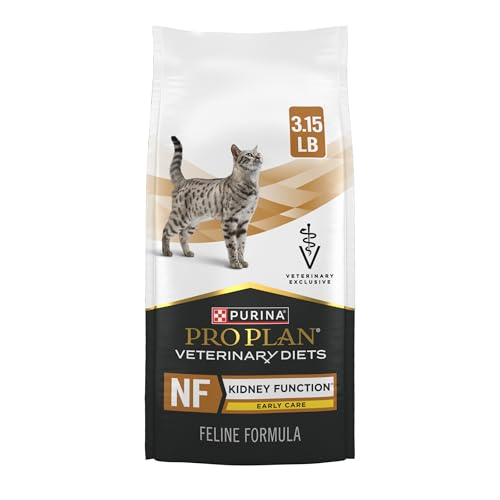
Precision nutrition for early-stage defense—Purina’s Pro Plan NF formula is a strategic shield for cats showing first signs of kidney stress. With controlled phosphorus and moderate protein, it’s engineered to slow disease progression before symptoms escalate, making it a proactive powerhouse rather than a crisis response. The omega-3 fatty acids (EPA & DHA) aren’t just for coat shine—they combat inflammation at the cellular level, a critical factor in preserving renal tissue. And with antioxidants for immune support, it addresses the whole-body impact of early kidney changes.
In practice, the kibble is readily accepted, though it lacks the Enhanced Appetite Trigger found in Hill’s k/d, making it less aggressive in stimulating hunger. It performs well as a daily maintenance food, especially for younger seniors (9–12 years) with borderline lab values. The moderate protein level strikes a balance—not so low that it causes muscle loss, not so high that it stresses kidneys. However, it doesn’t include prebiotics like ActivBiome+, so it’s less comprehensive in gut-kidney axis support than top-tier competitors.
When compared to Hill’s k/d, this Purina NF formula excels in early intervention but falls short in advanced support. It’s not as aggressively therapeutic, but perfectly calibrated for prevention. For cats not yet in full renal failure, this is the most scientifically grounded choice to extend kidney longevity.
Forza10 Vet-Formulated Renal Wet Cat Food Lamb
ADVANTAGES
LIMITATIONS
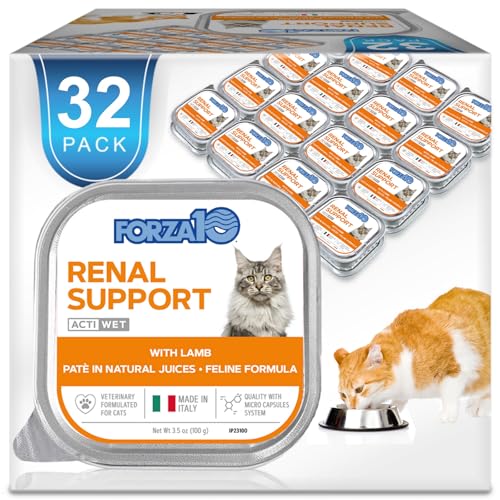
Italian craftsmanship meets renal science in Forza10’s lamb-flavored wet food—a sophisticated option for owners seeking clean-label, vet-formulated nutrition. The hydrolyzed protein and potato base ensure controlled phosphorus and adapted protein levels, while cranberries, dandelion, and clover extract add natural kidney-supportive phytonutrients. Free from GMOs, by-products, wheat, and artificial additives, it’s a premium choice for holistic-minded pet parents who won’t compromise on ingredient quality. With 32 cans per pack, it’s built for daily, long-term feeding without breaking routine.
In use, the lamb flavor is well-received, though not as universally appealing as chicken-based formulas. The 3.5 oz size is practical, offering a balanced portion for most adult cats. The texture is smooth but not overly dense, making it suitable for cats with mild dental issues. It pairs well with dry food for mixed feeding, enhancing hydration without overwhelming the bowl. However, it lacks clinically proven additives like ActivBiome+, so its mechanism of action is more supportive than transformative.
Against Hill’s k/d, Forza10 trades broad clinical validation for purity and origin transparency. It’s not the first choice for advanced disease, but ideal for cats in early decline or sensitive to common allergens. For owners who value “what’s not in the can” as much as what is, this is the most refined, ethically crafted renal wet food available.
Renal Cat Food Comparison
| Product | Best For | Phosphorus Level | Protein Level | Appetite Support | Texture/Form | Key Ingredients/Features |
|---|---|---|---|---|---|---|
| Hill’s Prescription Diet k/d Dry Cat Food | Best Overall | Reduced | High Essential Amino Acids | Enhanced Appetite Trigger (E.A.T) | Dry Kibble | ActivBiome+ Kidney Defense, Chicken Flavor |
| Hill’s Prescription Diet k/d Stew Variety Pack | Best Wet Food Variety | Reduced | Moderate | Palatable Flavors | Wet Stew | ActivBiome+ Kidney Defense, Variety Pack |
| Hill’s Prescription Diet k/d Starter Kit | Best for Transitioning Diets | Reduced | High Essential Amino Acids | Enhanced Appetite Trigger (E.A.T) | Dry & Wet Variety | ActivBiome+ Kidney Defense, Variety of Flavors/Textures |
| Royal Canin Renal Support E Loaf in Sauce | Best for Appetite Stimulation | Low | Targeted | E = Enticing Loaf Texture | Wet Loaf in Sauce | Antioxidant Complex, Fatty Acids, Palatable |
| Royal Canin Renal Support D Thin Slices in Gravy | Best Texture for Picky Cats | Low | Targeted | D = Delectable Texture | Wet Slices in Gravy | Antioxidant Complex, Fatty Acids, Palatable |
| Forza10 Vet-Formulated Renal Wet Cat Food Lamb | Best Italian Formulated Wet Food | Controlled | Hydrolyzed Protein | Savory Lamb Flavor | Wet | Hydrolyzed Protein, Cranberries, Dandelion, Clover Extract |
| Pro Plan NF Early Care Dry Cat Food | Best for Early-Stage Kidney Care | Controlled | Moderate | Palatable Flavor | Dry | Antioxidants, Omega Fatty Acids |
| Dave’s Pet Food Renal Cat Treats | Best Kidney-Support Treats | Low | Low | Chewy Recipe | Semi-Moist Treats | Prebiotics, Sweet Potato, Fiber-Rich |
How We Evaluated Renal Cat Foods
Our recommendations for the best cat foods for renal health are based on a rigorous analysis of nutritional data, veterinary research, and product specifications. We prioritized formulas aligning with established guidelines for managing Chronic Kidney Disease (CKD) in felines, focusing on key nutrients like phosphorus and protein.
We examined guaranteed analysis data from manufacturers, converting all values to a dry matter basis for accurate comparison, ensuring phosphorus content remained consistently below 0.8% – a critical threshold for slowing CKD progression. Protein levels were assessed for appropriateness, favoring moderate restriction with high-quality sources.
Beyond macronutrient profiles, we investigated the inclusion of beneficial additives like omega-3 fatty acids, prebiotics (e.g., ActivBiome+), L-carnitine and antioxidants, noting their potential to support kidney function and overall well-being. We cross-referenced ingredient lists with current veterinary recommendations and considered factors influencing palatability – a vital component for compliance in cats with decreased appetite. Finally, we incorporated insights from peer-reviewed studies on feline renal diets and consulted with veterinary nutritionists to validate our findings, ensuring our selections reflect the latest advancements in renal health management.
Choosing the Right Food for Your Cat with Renal Disease
Managing your cat’s renal (kidney) health through diet is crucial for their quality of life. Selecting the best cat food requires understanding a few key features and how they address the specific needs of cats with kidney disease. Here’s a breakdown to help you make an informed decision.
Phosphorus Control: The Cornerstone of Renal Diets
Perhaps the most important factor is phosphorus content. Healthy kidneys filter phosphorus from the blood, but as kidney function declines, phosphorus builds up. High phosphorus levels worsen kidney damage, creating a vicious cycle. Renal diets are specifically formulated with reduced phosphorus levels. Look for foods clearly stating “low phosphorus” on the label and check the guaranteed analysis – ideally, you want a phosphorus level below 0.8% on a dry matter basis. Controlling phosphorus slows disease progression and helps your cat feel better for longer.
Protein Levels: Finding the Right Balance
Protein restriction is another critical aspect of renal diets, but it’s more nuanced than simply choosing the lowest protein option. While severely restricting protein was once standard advice, current understanding leans towards moderate protein restriction, especially in early stages of kidney disease. Cats need protein to maintain muscle mass, and excessive restriction can lead to muscle loss and weakness. Look for foods with high-quality, easily digestible protein sources, and levels appropriate for the stage of your cat’s disease (your vet can advise). Some foods also include added amino acids to support muscle maintenance.
Palatability and Texture: Ensuring Your Cat Eats
Cats with kidney disease often experience a decreased appetite. A food that isn’t eaten is useless, no matter how perfectly formulated! Palatability is therefore incredibly important. Consider:
- Flavor Variety: Offering different flavors (chicken, fish, etc.) can help entice a finicky eater. Variety packs are a good option.
- Texture: Some cats prefer wet food, others dry. Some prefer pate, others gravy-based foods. Experiment to find what your cat enjoys. Wet food can also provide extra hydration, which is beneficial for kidney health.
- Enhanced Appetite Triggers: Some formulas include ingredients specifically designed to stimulate appetite.
Additional Beneficial Features
- ActivBiome+ Kidney Defense (or similar prebiotics): Some foods contain prebiotics to support gut health. A healthy gut microbiome can help reduce the build-up of toxins that kidneys would normally filter.
- Omega-3 Fatty Acids: These can help reduce inflammation and support overall health.
- Antioxidant Complex: Helps protect cells from damage.
- L-Carnitine: Supports muscle mass and energy levels.
- Convenience (Starter Kits): If transitioning to a new diet, a starter kit with multiple flavors and textures can help you find what your cat likes best.
The Bottom Line
Choosing the right renal diet is a vital step in supporting your feline companion’s health and well-being. Remember to prioritize foods with controlled phosphorus levels, moderate protein, and appealing flavors and textures to ensure your cat enjoys their meals and receives the necessary nutrition.
Ultimately, working closely with your veterinarian is key to determining the best dietary plan for your cat’s individual needs and stage of kidney disease. They can provide personalized recommendations and monitor your cat’s progress, helping you to provide the best possible care and maintain their quality of life for years to come.
