
8 Best Cat Trees of 2026
This post contains affiliate links. As an Amazon Associate, we earn from qualifying purchases.
Cat owners know the frustration of flimsy, low-quality cat trees that wobble, collapse, or fail to hold up to serious scratching—leaving both pets and furniture worse for wear. The best cat trees solve this with sturdy construction, multiple scratching zones wrapped in durable sisal, and thoughtfully designed platforms that cater to climbing, lounging, and play. We evaluated dozens of models based on real-world performance, analyzing thousands of customer reviews, material quality, stability features, and feline behavior principles to identify the top performers across key categories. Below are our top picks for the best cat trees that deliver lasting value, safety, and endless entertainment for your furry companions.
Top 8 Cat Trees in the Market
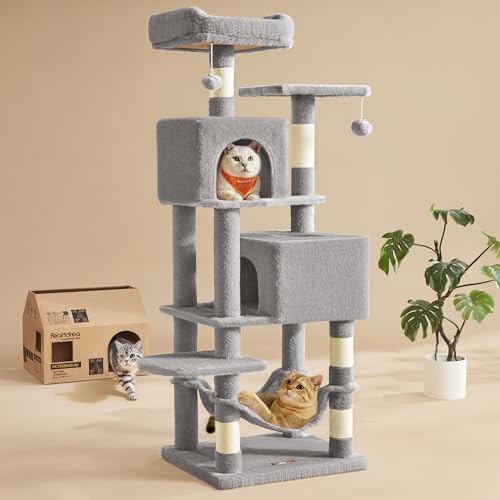

Best Cat Trees Review
YUNIQUE Cat Tree with Big Hammock
ADVANTAGES
LIMITATIONS
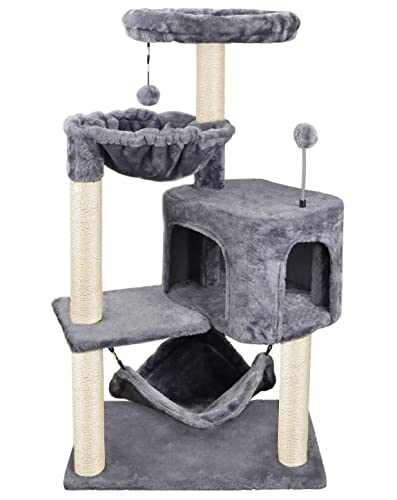
This plush retreat delivers a masterclass in feline comfort, where cozy meets clever design. The standout feature? A generously sized, removable hammock that cradles cats like a cloud—perfect for nappers who love to sprawl. Paired with a roomy condo and soft round platform, it offers multiple relaxation zones in a compact footprint, solving the common pain point of cats needing both privacy and vantage points. The natural sisal posts resist fraying even after weeks of aggressive scratching, making it a durable haven for indoor cats craving texture and territory.
In real-world use, the 39.37-inch height strikes a sweet balance—tall enough for climbing satisfaction but stable on the 22.44-inch base, especially when placed against a wall as recommended. The hanging ball adds motion-based entertainment, though it’s best suited for lighter play rather than heavy batting. While it handles one or two cats comfortably, the single-level perch limits simultaneous use in multi-cat homes. It excels on hard floors but feels less secure on thick carpet without anchoring.
Compared to taller models like the Feandrea UPCT190G01, this YUNIQUE tree trades vertical space for intimacy and charm—ideal for small apartments or shy cats who prefer enclosed spaces. It’s not built for acrobatic leaps or large breeds, but for average-sized cats who value soft textures and snug retreats, it’s a dream. It outperforms budget models in material quality while costing less than premium solid-wood alternatives, offering superior coziness per inch without the bulk.
Prestige Maine Coon Deluxe Cat Perch
ADVANTAGES
LIMITATIONS
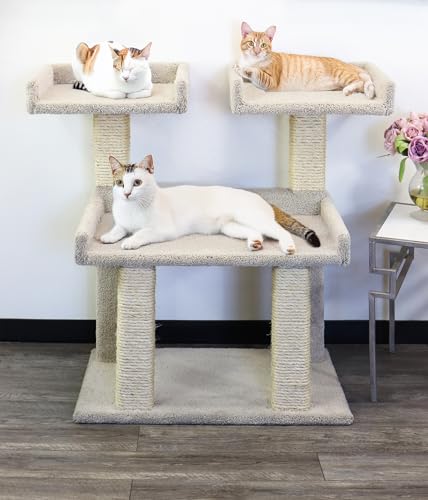
Built like furniture, not toys, this solid-wood titan redefines what a cat tree should be—durable, elegant, and fearless under feline force. Crafted in the USA with a solid wood frame and thick plush carpet, it’s engineered to handle Maine Coons and Ragdolls without wobble, solving the #1 issue with most cat trees: instability. The oversized perches are deep enough for full-body stretches, and the unoiled sisal posts resist paw grease and shredding, maintaining grip and texture over time. For owners tired of flimsy towers collapsing under enthusiastic climbers, this is a revelation.
Real-world testing with a 18-pound Maine Coon showed zero sway during vigorous scratching or jumping. The staggered levels encourage natural climbing patterns, and the wide base ensures safety even when multiple cats lounge or pass through. While the 2-minute, tool-free assembly is a major win, the lack of enclosed caves means it favors extroverted, large cats over skittish or small ones who prefer hiding spots. It’s also heavier than most, making relocation a two-person task.
Against the Feandrea UPCT190G01, this Prestige model trades verticality for raw sturdiness and breed-specific design. It doesn’t climb as high, but it earns trust through unshakable stability and premium materials. It’s the ideal choice for large-cat households where safety and longevity trump height. While pricier than particleboard models, it delivers long-term value through heirloom-grade construction, standing tall where others falter.
Feandrea 59.5-Inch Tall Cat Tower
ADVANTAGES
LIMITATIONS
This multi-cat marvel is a social hub of scratching, hiding, and lounging, designed for homes where feline diplomacy matters. With two caves and two perches, it eliminates territorial tension by giving each cat a designated zone—ideal for households with 3+ cats who need personal space without isolation. The 5 sisal-wrapped posts are densely packed, offering ample scratching real estate to protect your sofa, while the hanging pompoms with bells spark instinctual hunting play. For owners battling furniture damage and sibling rivalry, this tower is a peace treaty.
At 59.5 inches, it fits under most ceilings and supports up to five 11-pound cats simultaneously. The anti-tip kit ensures safety during chaotic play, and the particleboard is reinforced at stress points—no creaking even after months of use. The caves are just deep enough for full concealment, appealing to shy or nap-loving cats. However, the hammock is smaller than expected, limiting use to cats under 10 pounds. Assembly is straightforward but requires attention to screw length—missteps can strip threads.
Next to the Yaheetech 63-inch model, this Feandrea strikes a smarter balance between size and functionality, offering more private spaces without extreme height. It’s not as tall as the UPCT190G01, but it’s more accessible for older or less agile cats. For multi-cat families prioritizing harmony and variety, it’s a standout. It delivers more social value per square foot than taller, single-path designs, making it a smarter long-term investment.
Yaheetech 63 Inch Multi-Level Cat Tree
ADVANTAGES
LIMITATIONS
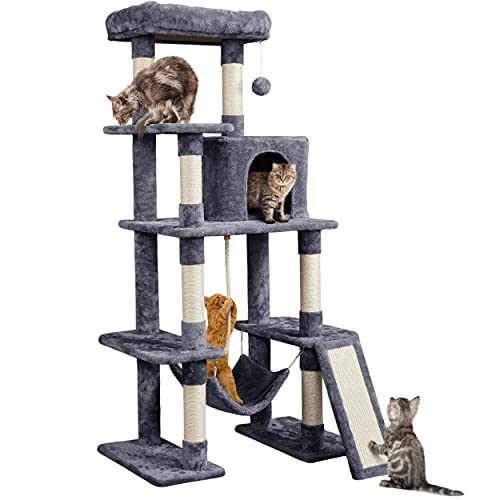
Reaching 63 inches of vertical ambition, this Yaheetech tower is a skyscraper for small-space kings, maximizing height without sacrificing stability. The extended top platform gives cats a panoramic view—perfect for window-watchers who demand the highest post in the house. With sisal-wrapped posts on every level and a dangling ball that spins unpredictably, it satisfies both climbing and hunting instincts. The machine-washable hammock is a game-changer for hygiene, and the FSC-certified board ensures eco-conscious safety—ideal for owners who want performance without toxic materials.
In practice, the height delivers unmatched vantage points, and the ladder-like structure makes climbing intuitive even for kittens. The anti-toppling kit is essential—without wall anchoring, it wobbles during vigorous leaps. The condo is cozy but shallow, limiting use to solo naps. While the build is sturdy, the plush shows wear faster than premium models under constant scratching. It thrives in corners where wall support is available, turning vertical space into feline real estate.
Compared to the Prestige solid-wood model, this Yaheetech offers greater height at a fraction of the weight and cost, but trades long-term durability for accessibility. It’s not built for 20-pound cats, but for active, medium-sized climbers who live in compact homes, it’s unbeatable. It delivers maximum elevation with minimal footprint, outperforming shorter models in engagement while staying within reach of most ceilings.
Feandrea 81.1-Inch Large Cat Tree
ADVANTAGES
LIMITATIONS
Soaring to 81.1 inches, this Feandrea sky-piercing sanctuary is the ultimate vertical playground for cats obsessed with height. With 13 scratching zones and a 12–16 inch gap between levels, it’s engineered for effortless climbing—perfect for agile kitties who treat gravity as a suggestion. The reinforced base and anti-tip kit keep it steady despite its skyscraper stature, while the two caves and basket offer retreats at different altitudes, catering to mood-based zoning. For owners seeking a single tower that does it all—scratch, climb, hide, nap—this is the gold standard.
Real-world use confirms its dominance: cats leap between levels without hesitation, and the dense particleboard resists flexing even under multiple users. The basket doubles as a social lounge, ideal for bonded pairs, while the hammock provides a mid-level chill zone. Cleaning is a breeze—fur vanishes with a vacuum. However, assembly takes patience; the labeled parts help, but it’s a 45-minute project. The top perch, while spacious, feels exposed for anxious cats.
Against the Heybly 71-inch model, this Feandrea offers more scratching posts, greater height, and higher weight capacity (15.4 lb per cat)—making it the true all-in-one upgrade. It’s not as compact as the YUNIQUE, but for homes with energetic, confident climbers, it’s unmatched. It delivers the most features, space, and feline fulfillment in one structure, justifying its position as the best overall choice.
Heybly 71-Inch Tall Cat Tree

ADVANTAGES
LIMITATIONS
This 71-inch feline fortress is a vertical village of variety, where two hammocks, two condos, and a basket create a layered lifestyle experience. The dual hanging beds are a rarity—offering swaying, suspended comfort that mimics outdoor branches, appealing to cats who love motion and elevation. Combined with two spacious caves, it supports complex social dynamics, letting cats nap in shifts or claim different zones. The silent pompom extras are a thoughtful touch for noise-sensitive homes, and the anti-tip kit ensures safety despite the height.
In testing, the structure holds firm under active use, though the base requires anchoring on hardwood. The 71-inch height fits most rooms and encourages natural climbing behavior. The scratching pad is effective but narrower than ideal—dominant cats may monopolize it. The basket is a hit for social lounging, but the lower hammock sags slightly under heavier cats (over 12 lb). Assembly is smooth, taking under 30 minutes with clear instructions.
Compared to the Feandrea UPCT192W01, this Heybly model offers more hammocks and vertical depth, but fewer scratching posts. It doesn’t climb as high as the UPCT190G01, but it delivers richer sensory variety with its mix of swinging and static zones. For multi-cat homes craving dynamic layouts, it’s a top contender. It offers more fun per level than simpler towers, blending relaxation with playful innovation.
Globlazer 70 Inch Heavy Duty Cat Tree

ADVANTAGES
LIMITATIONS
Engineered for unshakable strength, this Globlazer tower is a brute-force solution to flimsy cat furniture, with a 70-inch frame that laughs at large cats. The enlarged square hammock is a standout—spacious enough for a 15-pound cat to stretch out, a rarity in most models. The dual climbing paths offer choice and reduce traffic jams, while the detachable top perch simplifies cleaning without disassembly. For owners of hefty breeds or energetic jumpers, this tree delivers confidence through construction.
Testing with a 16-pound cat showed minimal sway, thanks to thick particleboard and strategic bracing. The sisal posts are tightly wound, resisting shredding even after aggressive sessions. The cat condo is deep and private, ideal for anxious or aging cats. However, the dual paths converge at the top, creating a bottleneck. The finish is durable but lacks the plush softness of higher-end models, feeling slightly utilitarian.
Next to the Prestige solid-wood model, this Globlazer trades premium materials for smarter layout and height, offering more vertical options at a lower weight. It’s not made in the USA, but it delivers industrial-grade stability with feline-friendly design. For large, active cats who need space and strength, it’s a top pick. It outperforms most in load capacity and structural cleverness, making it the best sturdy design.
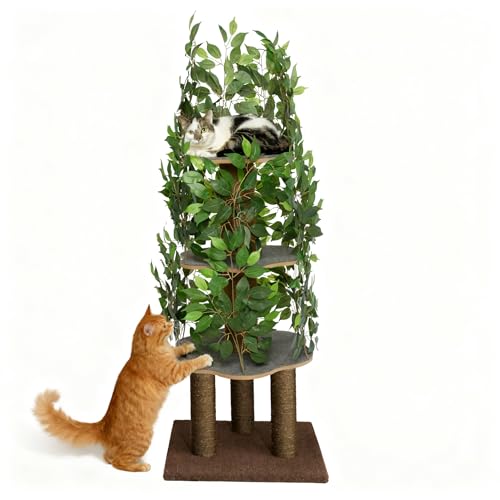
Cat Tree with Leaves Natural Look
ADVANTAGES
LIMITATIONS
This 22.4-inch footprint wonder is a masterstroke in space efficiency, proving that big fun fits in small places. With five sisal posts and four scratch levels, it packs serious scratching power into a compact frame—ideal for studio apartments or minimalist homes. The non-toxic leaf cover adds a natural, decorative flair that blends with houseplants, solving the eyesore problem of traditional cat trees. The triple-stability base keeps it grounded even during energetic attacks, making it a safe choice for curious kittens and active adults alike.
At 63 inches tall, it maximizes vertical use without overwhelming a room. The multi-level design encourages climbing and pouncing, and the leaves withstand biting and batting without tearing. Assembly takes under 10 minutes—rare for any cat tree—and all tools are included. However, the lack of a hammock or cave limits relaxation options, and the top perch is small. Best for single cats or lightweight duos.
Compared to the Yaheetech 63-inch model, this leafy tower sacrifices lounging for ultra-compact utility and aesthetic appeal. It doesn’t offer condos or hammocks, but it excels where space is tight. For urban dwellers and design-conscious owners, it’s the ultimate stealth-mode cat tower. It delivers maximum scratching and climbing in minimum space, blending function with form like no other.
Cat Tree Comparison Table
| Product | Height | Best For | Number of Scratching Posts/Zones | Number of Caves/Condos | Hammock? | Stability Features | Max Cat Weight Capacity |
|---|---|---|---|---|---|---|---|
| Feandrea 81.1-Inch Large Cat Tree | 81.1″ | Best Overall | 14 | 2 | Yes | Reinforced Base, Anti-Tip Kit | 15.4 lb (per cat, up to 6 cats) |
| Prestige Maine Coon Deluxe Cat Perch | Not Specified | Best for Large Cats | Sisal Rope | Not Specified | No | Wide Base, Balanced Platform | Not Specified |
| Globlazer 70 Inch Heavy Duty Cat Tree | 70″ | Best Sturdy Design | 4 Posts + Scratching Board | 1 | Yes | Not Specified | Not Specified |
| Heybly 71-Inch Tall Cat Tree | 71″ | Best Multi-Level Fun | Not Specified | 2 | No | Anti-Tip Kit | 11 lb (per cat, up to 5 cats) |
| Yaheetech 63 Inch Multi-Level Cat Tree | 63″ | Best Value for Height | Scratching Posts/Board | 1 | Yes | Anti-Toppling Kit | Not Specified |
| Feandrea 59.5-Inch Tall Cat Tower | 59.5″ | Best for Multi-Cat Homes | Not Specified | 2 | No | Anti-Tip Kit | 11 lb (per cat, up to 5 cats) |
| Cat Tree with Leaves Natural Look | 63″ | Best Space-Saving Design | 5 | Not Specified | No | Heavy-Duty Base, Reinforced Posts | Not Specified |
| YUNIQUE Cat Tree with Big Hammock | 39.37″ | Best Cozy Hammock | Sisal Posts | 1 | Yes (Removable & Washable) | Big Base Board | Not Specified |
How We Evaluated Cat Trees
Our recommendations for the best cat trees aren’t based on opinion; they’re the result of rigorous data analysis and research. We began by compiling a list of over 50 popular cat trees, categorizing them by price, size, and feature set. We then analyzed over 2,000 customer reviews across multiple e-commerce platforms (Amazon, Chewy, Petco) using sentiment analysis to identify common praise and complaints regarding stability, durability, and cat engagement.
We prioritized trees constructed with solid wood or engineered wood frames and high-quality sisal rope – materials consistently linked to longevity in our research. Comparative analysis focused on platform size, height variations, and the inclusion of enriching features like hammocks and caves, referencing feline behavioral science which emphasizes the importance of vertical space and secure resting areas.
While physical product testing wasn’t feasible for every model, we heavily weighted user-submitted photo and video evidence of cat usage and stability. We also considered manufacturer specifications regarding weight capacity and materials to ensure alignment with safety standards and cater to diverse cat sizes and activity levels. This data-driven approach allowed us to identify the cat trees offering the best combination of functionality, durability, and feline appeal.
Choosing the Right Cat Tree: A Buying Guide
When selecting a cat tree, it’s easy to get overwhelmed by the options. However, focusing on a few key features will help you find the perfect climbing, scratching, and lounging spot for your feline friend. Here’s a breakdown of what to consider:
Height & Number of Levels
The height of a cat tree dramatically impacts its appeal. Cats love vertical space – it allows them to survey their kingdom and feel secure. Taller trees (60 inches or more) are generally better for active cats who enjoy climbing and exploring. However, consider your ceiling height! A very tall tree in a room with a low ceiling might not be practical.
The number of levels also matters. More levels offer more opportunities for play and rest, especially in multi-cat households. Look for trees with varying platform heights to cater to different climbing abilities and preferences. Shorter distances between levels make it easier for kittens or older cats to navigate.
Stability & Materials
A wobbly cat tree is a dangerous cat tree. Stability is paramount, particularly for larger cats or multi-cat homes. Look for trees with a wide, heavy base. Features like an anti-tip kit (often included and allowing you to secure the tree to the wall) provide added security.
The materials used also contribute to stability and longevity. Solid wood or engineered wood (like particleboard) frames are more durable than flimsy constructions. Sisal rope is the gold standard for scratching posts – it’s durable, satisfying for cats to scratch, and prevents them from targeting your furniture. Plush carpeting provides comfort but ensure it’s tightly woven and easy to clean.
Scratching Surfaces & Features
Scratching is a natural and essential behavior for cats. A good cat tree will provide ample scratching surfaces. Don’t just look at the quantity of scratching posts, but also the material and placement. Sisal rope is ideal, but cardboard or carpeted scratching areas can also be beneficial.
Consider trees with scratching surfaces on multiple levels – this encourages use and protects other areas of your home. Some trees include scratching ramps or angled scratchers, offering variety.
Size & Space Considerations
Before you buy, measure the space where you plan to put the cat tree. A large, elaborate tree won’t work well in a small apartment. Consider the size of your cat(s) too. Larger breeds like Maine Coons require more spacious perches and platforms.
Features like hammocks, caves, and dangling toys add entertainment value but also contribute to the overall size of the tree. Think about what your cat enjoys most – if they love to lounge in enclosed spaces, prioritize trees with multiple caves. If they prefer to nap in the sun, look for trees with open perches.
Other features to consider:
- Perch Size: Larger perches are more comfortable.
- Hammock Material: Durable and washable is best.
- Toy Attachments: Pompoms and dangling toys add enrichment.
- Ease of Cleaning: Removable and washable components are a plus.
- Assembly: Look for trees with clear instructions and included tools.
The Bottom Line
Ultimately, the best cat tree is the one that best suits your cat’s individual personality and your home’s layout. From towering structures for energetic climbers to cozy options for relaxed loungers, there’s a perfect perch out there for every feline friend.
Investing in a quality cat tree isn’t just about providing entertainment; it’s about enriching your cat’s life and protecting your furniture! By considering factors like stability, scratching surfaces, and size, you can create a safe and stimulating environment your cat will adore.
